

Let’s talk good stuff like food and kids and family and connection. (Just writing that makes me feel good!) We’re not going to focus on fancy meals, or a traditional dinnertime. We’re going to talk about using food as a way, and as a reason, to connect with your kids, to your family. Because one of the first things you learn when you become a parent, is that your child is going to need to eat multiple times day forevermore. Dinnertime happens every single day.


It can feel relentless, I know. But the relentlessness is also an advantage. It’s an opportunity. It means that every single day, even when your kids get older and busier, you’ll get a chance to connect with them. Because everyone needs to eat. Every one needs to eat every day.

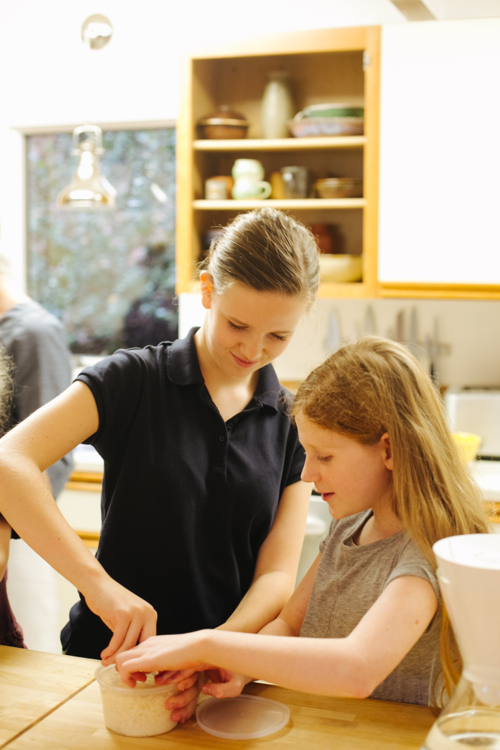


So at some point in our parenting journey, we decided we might as well look for ways to make the most of mealtime. Three things we’ve learned so far along the way:
1) The value, and the opportunity, isn’t just found in the actual sitting down and eating. We consider “dinnertime” to include the preparation, the eating, and the cleanup. And we’ve found there is quality time in all three of those categories. Picture stress-free conversations when you’re chopping vegetables side-by-side — busy hands and calm minds. Think of the casual chatting that happens over dishes, while everyone is satiated and happy. Think of the chance to model good behavior and good manners through out the tasks and the meal. Think of the repetition required for a child to learn how to properly wipe down a countertop or sweep a floor — and how daily eating can provide that repetition.
So we don’t call our kids to the kitchen when it’s time to eat. We call them when it’s time to start cooking. : )

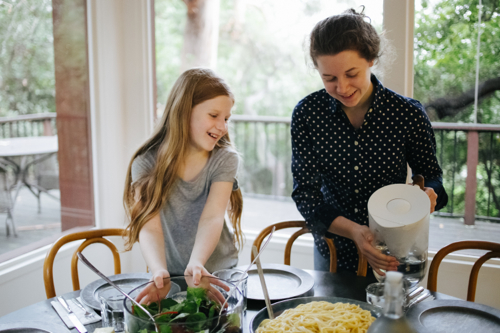
2) As I mentioned earlier, feeding the kids — heck, feeding yourself — is relentless. And sometimes it’s hard to give it any mental energy. There are days where we just don’t have it in us to come up with a menu, or make a trip to the grocery store. So we’ve had to come up with some tried and true “pantry” recipes to fall back on.
Our suggestion is to come up with at least three meals you can make with food you can keep on your pantry shelves. Maybe a pasta dish with sauce made from canned tomatoes. Maybe a split pea soup. Simple recipes that you’ve committed to memory, and that you know your family will eat. Maybe it’s even a no-cook option like crackers and olives and pickles and cheese and salami. When you have one of those days where you don’t want to think about food, you’ll know you’ve got a meal waiting for you in the cupboard.

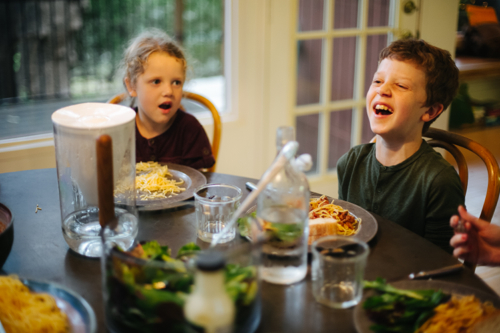

3) There are nights when the family feels chatty, and there are other times when it’s harder for people to relax. So we like the idea of having a conversation tradition — something flexible, not rigid — to facilitate conversation. You could let a different person pick the topic of conversation each night. You could take turns reviewing the food as if you’re a judge on a Food Network show. You could go around the table, each person sharing 2 good things and 1 bad thing that happened that day.
You might come up with 10 different conversation traditions and choose a different one each night! Talking and connecting over food is one of life’s great pleasures. Having a few prompts at the ready simply helps you make the most of it.

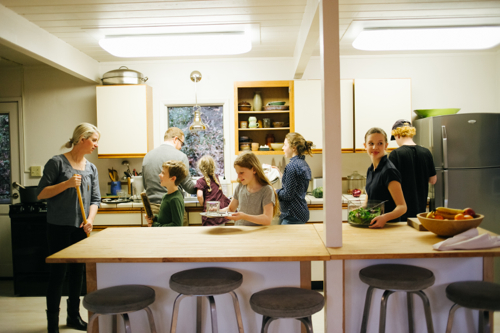
What about you? What are mealtimes like at your house these days? Do you have a no screens at the table rule? Do you play music in the background? Do you like eating at the dinner table, or do you prefer to keep it more casual and eat at the kitchen island or kitchen counter? (We do a lot of island eating at our house.) Are you in the baby stage? Do you have gloomy teens that need those conversation prompts? Do you love cooking? Do you dread cooking? I’d love to hear what it’s like for you! I always love to hear what you have to say.
Photos by Katrina Davis for Design Mom (back when I was still blonde!).
This is so spot on! I work for an eating disorder residence and the one thing most, if not all, clients lack is a structured and fun eating environment.
When I’m home (I’m currently in college), we always eat together. Growing up, we pretty much always ate in the dining room, but as we became teenagers, we started eating at our huge kitchen island. I think the dining room was more of a safety thing- our stools at the island are pretty tall for little kids to fall from!
Love the water pitcher- where did you get it?
This post makes my heart happy in ways I can’t describe. The photos speak love and I’m just sitting here feeling warm fuzzies because of it. You’re a good mum. x
i love this. LOVE THIS. My grandmother was BIG on this, we all got involved ALL of the time…I learned the ‘proper way’ to cut up a chicken before I was five. It is important. In our family, the men ‘skinned ’em, and the women fix ’em’ but it was a combined effort…(we are SUPER southern, and we hunt and fish for our own meat) but I loved it. The memories and lessons have carried me through life.
Same here! – super Southern, hunt and fish all our own meat, everyone involved in meal prep. I used to fight against it until I had a daughter of my own and now it’s those food traditions I find myself wanting to pass down the most!
I’d love more ideas on having kids help in the kitchen! Because all my kids are young I usually try to have dinner mostly made before they get home from school so I can give as much attention as I can (with a demanding toddler) to homework help and etc. They love when they get to help with peeling and cutting vegetables, and my 9 year old recently made baking powder biscuits. I’ve noticed that if we can engage in interesting conversation–usually about current national or world events–we stay at the table longer together and have a more enjoyable dinnertime.
We have a no screen policy (and before that a no toy policy), we play Pandora in the background, kids set the table and gather condiments (olives, grated cheese, ketchup, sriracha!) and we all sit down together every single night. On the weekends, it’s breakfast as well. If someone has an obligation (soccer, music, a late meeting), it simply alters the TIME we eat, we still manage to eat together. I make a weekly meal plan and if a day of that week calls for a later meal, the menu will reflect that. When one of us ill or unavailable (business trip) it’s definitely a more solemn meal. As for brooding teenagers, I find they show up when the prepping begins at the kitchen island and it’s one of the very best times to talk with them (second only to long drives alone with Mom).
….I wanted to add that not everyone likes every menu item. There’s a long standing rule that you cannot EVER under any circumstance denigrate what is being served. It’s insulting to the cook and inconsiderate to the time spent preparing dinner for a large family. That person is welcome to make a meal of the components (just salad and garlic bread, maybe rice with veggies and no chicken), but eating a complete substitute (cereal and milk) is NOT acceptable. The result is they’ve become quite mannered at refusing food, “you know what Mom? chicken dijon isn’t my favorite, I’ll just have salad and plain noodles…”, which is far far far more palatable than “ewww, chicken, yuck”.
We are addicted to eating meals together at our house. It doesn’t always involve clean up and prep, but we do get together to eat. It’s hard with baseball and choir practices etc., but when that happens we do our best. Missing meals is not the norm. Over the years, the “gloomy teens” have arrived. We have a no screen, no 3rd degree questioning policy. Instead, to de-stress from work and homework we do trivia quizzes from a book. We found a book with a set of questions for each day. We each guess an answer and see how we’ve done. It’s non-competitive. The guesses can be silly or serious and often lead to conversations we know would never have happened without the trivia topic. Not to mention, it shows the kids how much they have learned over the years, especially when they know way more than we do.
I love your trivia quiz idea. Could you pass on the name/publisher of the book?
Love this. I think everyone has much more appreciation of mealtime when they come together to make it happen.
we had a policy when we sat down to dinner to discuss with the kids “tell me one thing that happened at school today”……it opened a whole dialogue of different topics.
@Heidi – We have an 8 year old and a 3 year old, so I hear you about the needy demanding time just before dinner. The evening sometimes gets crazy if they don’t eat ASAP. :)
Both I and my husband work outside the home, so there’s just so little time between getting home and going to bed. But, in the past year we have committed to sitting down to dinner every night (some nights more successful than others).
To help out, we have a few simple dishes that both kids will eat that take 20 minutes or less to fix (lots of pasta, soups, muffins). We also encourage each of our kiddos to help out in whatever way they like. Our oldest prefers to set the table and drinks, our youngest prefers to “help” with cooking. This might be putting cut-up items in a bowl, or simply stirring, but she feels important if she can help. If the kids are super hungry, we feed them bites as we cook.
Not all evenings are perfect, but we try, try, try to sit down by 5:30pm and have a discussion at dinner. No screen time, no books (maybe music in the background). Discussions are fairly simply – but the kids sit longer and eat properly if they are chatting about their day. Our 3 year old is now in pre-school, so she often tells us about her friends, or music class. And, she now notices when she isn’t given enough time to talk. Anything I can do to encourage them to talk now feels like a success!!
Pingback: How to Nurture Your Family with Dinner Time • A Living Laboratory